PHP in 2026: The Comeback Language Nobody Saw Coming
Long written off as legacy plumbing, PHP enters 2026 faster, stricter, and more loved than it has been in a decade. Here's why the language behind 70% of the web is quietly having its best year yet.

Ahmad Tarabein
Software Developer · June 1, 2026
PHP in 2026: The Comeback Language Nobody Saw Coming
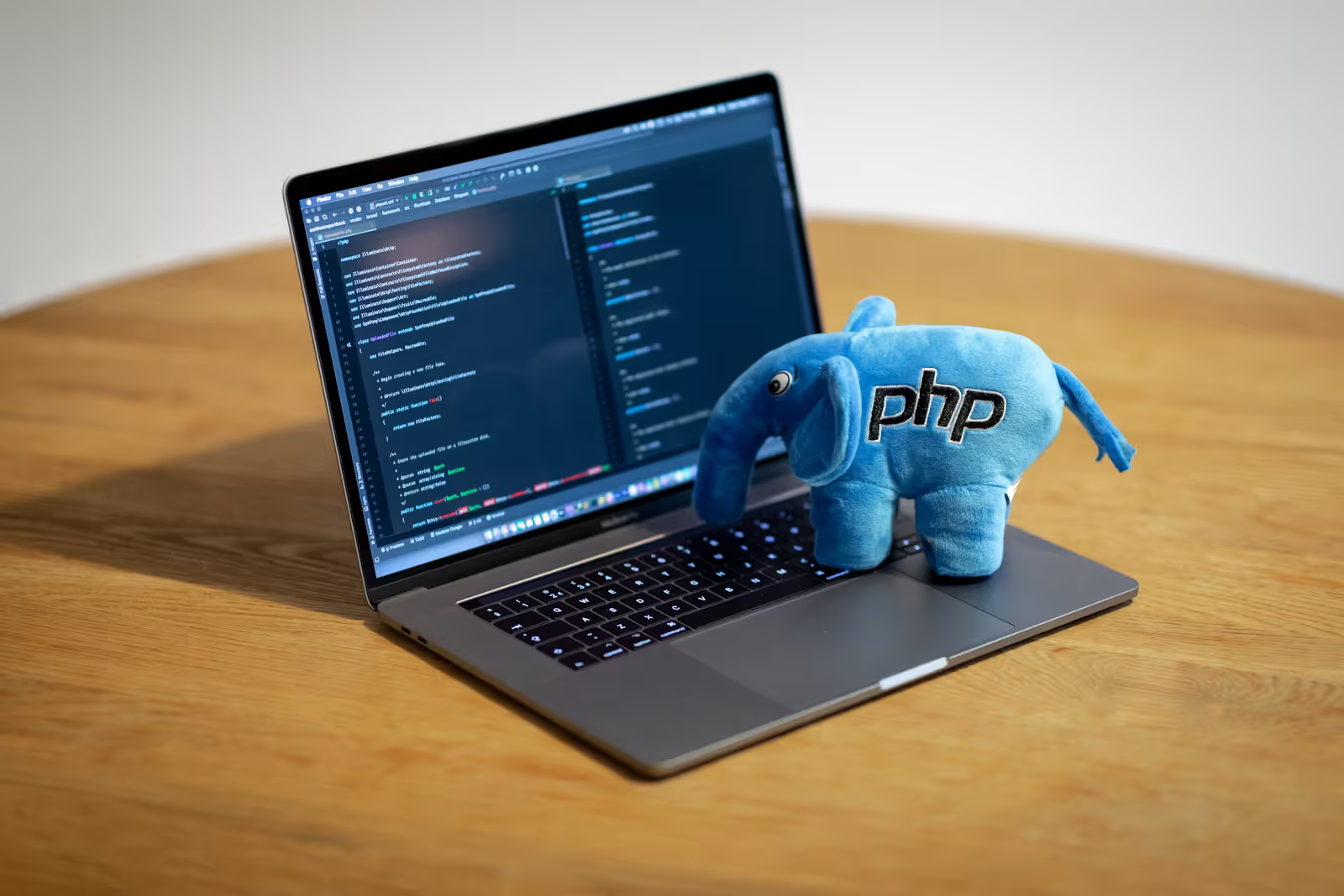
For the better part of a decade, PHP was the language developers loved to mock. It powered the web, sure, but in the way that asbestos once powered insulation: ubiquitous, unglamorous, and something you'd rather rip out than admit you depend on. In 2026, that narrative has quietly collapsed. PHP isn't just surviving. It's thriving.
The Numbers Still Don't Lie
PHP continues to run a staggering share of the web. Depending on which survey you trust, somewhere between 70% and 75% of all websites with a known server-side language still run PHP. WordPress alone, built on PHP, powers a plurality of the entire internet, and it shows no sign of relinquishing that crown.
But raw market share was never the interesting part. Plenty of "dead" technologies have enormous installed bases. What's changed in 2026 is the *trajectory* of the language itself.
PHP 8.x Made the Language Genuinely Good
The PHP 8 line, which began in late 2020, was a turning point that the wider industry took years to fully appreciate. By 2026, the cumulative effect is undeniable:
- The JIT compiler matured into something that meaningfully accelerates CPU-bound workloads, not just synthetic benchmarks.
- A real type system arrived in stages; union types, intersection types, enums, readonly properties, and never return types giving PHP a static-analysis story that rivals far younger languages.
- Fibers unlocked true asynchronous programming, paving the way for runtimes that keep PHP processes alive between requests.
The result is a language that feels modern. Strict typing plus tools like PHPStan and Psalm at max level can catch entire classes of bugs before code ever runs.
function divide(int $a, int $b): float
{
return $a / $b;
}
That signature, boring in most languages was simply not expressible in idiomatic PHP a decade ago.
The Runtime Renaissance
Perhaps the biggest shift is architectural. The classic PHP model boot the world, handle one request, throw everything away is no longer the only option.
Long-running application servers like FrankenPHP, Swoole, and RoadRunner keep the framework bootstrapped in memory across thousands of requests. The performance gains are dramatic: applications that once needed careful caching to hit acceptable latency now serve traffic with headroom to spare. FrankenPHP in particular, built on the Caddy web server and shipping as a single binary, has made "fast PHP" feel less like a hack and more like the default.
Laravel Became a Platform
You cannot talk about PHP in 2026 without talking about Laravel. What started as "Rails for PHP" has become a genuine application platform. Its first-party ecosystem for queues, real-time events, billing, deployment, and admin panels means a small team can ship a production SaaS with remarkably little glue code.
Symfony, meanwhile, remains the disciplined, enterprise-friendly counterweight, quietly powering a huge amount of the infrastructure that other frameworks (including parts of Laravel) are built on.
The Honest Caveats
PHP's comeback is real, but it isn't a clean sweep:
- The legacy tax is enormous. Billions of lines of PHP 5-era code still exist, and much of the language's bad reputation is earned by codebases that never moved on.
- Async is still bolted on. Compared to languages designed around concurrency from day one, PHP's async story requires opting into specific runtimes and libraries.
- The talent narrative lags reality. Many newer developers still skip PHP, assuming it's a dead end which ironically keeps senior PHP salaries healthy
So, Is PHP "Back"?
The honest answer is that PHP never left. What changed is us. The language matured faster than its reputation, and in 2026 the gap between perception and reality is wider than ever.
For greenfield projects, PHP is now a defensible, even excellent, choice, fast, strictly typed, backed by a deep ecosystem and a hosting story that's cheaper than almost anything else. It may never be fashionable. But in 2026, betting against PHP looks less like pragmatism and more like a failure to read the changelog.