Beyond Static Vectors: Why Rive is Replacing the Traditional Animation Handoff
For years, product teams have been forced to compromise on interface animation, squeezing bulky video files or rigid JSON strings into native apps. Rive changes the game entirely by building interactivity directly into the design asset, letting teams ship lightweight, state-driven graphics that respond to real-time data.

Ahmad Tarabein
Software Developer · May 21, 2026
The old pipeline for digital product animation is broken, and everyone knows it.
Typically, a motion designer spends days polishing a complex interaction inside Adobe After Effects, only to hand it off to an engineer who must then attempt to rebuild it from scratch using code or rely on Lottie to export a heavy, non-interactive JSON file. If a button needs to track a user’s cursor dynamically, or if an in-app character needs to react to live data, that traditional pipeline collapses.
Rive isn't just another vector graphics tool; it behaves more like a real-time game engine optimized for application software. It shifts the paradigm from linear, video-like playback to dynamic, state-driven user experiences.
The Secret Sauce: The State Machine
At the core of Rive’s magic is its native State Machine. Instead of exporting raw keyframes, designers map out logic directly within the workspace. They create "Inputs" (like booleans, numbers, or triggers) that act as a strict digital contract between the design asset and production code.
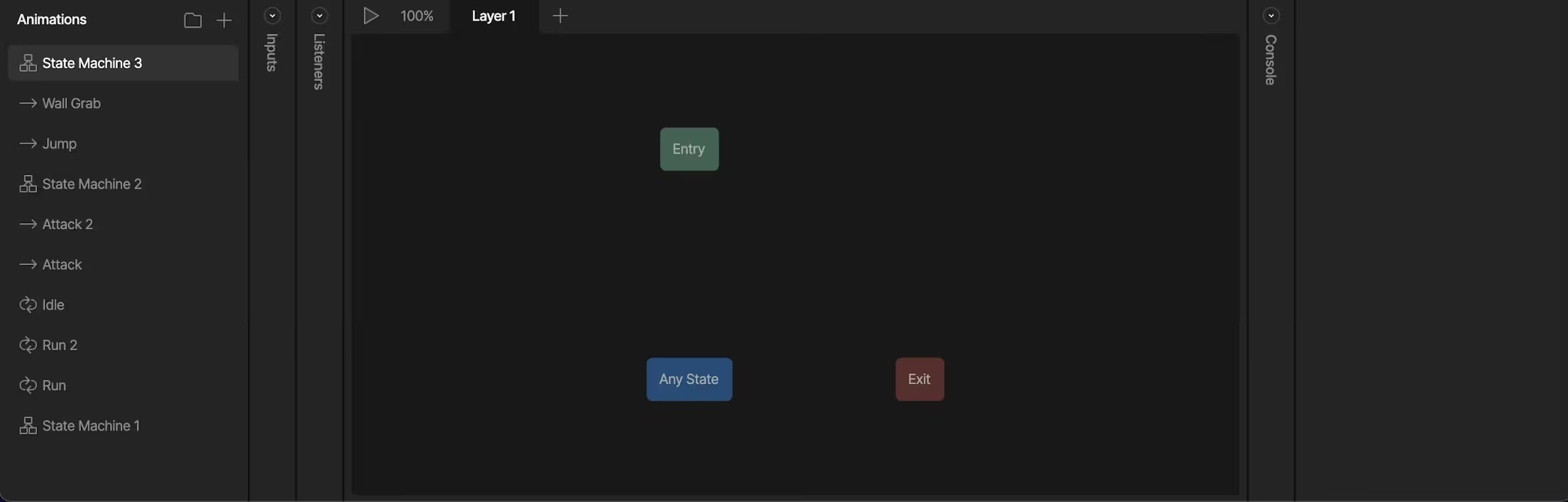
As seen in the visual editor above, you can link separate animation timelines like an Idle state, a Hovered loop, and a Clicked action using logic trees. If a user hovers over an asset, the file handles the smooth blending transition automatically.
Developers no longer have to manually choreograph timing arrays in code. They simply pass the application's native state to Rive's open-source runtime, and the asset handles the rest.
Why Teams are Migrating from Lottie and After Effects
Major products reaching billions of users—such as Duolingo, Spotify, and LinkedIn—have heavily integrated Rive into their core feature pipelines. The advantages boil down to three main pillars:
- Real-Time Data Binding: Rive allows UI elements like health bars, progress wheels, and text fields to accept live inputs. If a user's score increases, the animation scales dynamically at runtime rather than relying on pre-rendered steps.
- Insane Performance and Efficiency: Built on a custom, GPU-accelerated vector rendering engine, Rive assets run smoothly at 120fps. Because files are saved as ultra-lean
.rivvector data, they are often up to 90% smaller than matching Lottie deployments. - Native Code Scripting: Rive has introduced an ecosystem with an integrated coding agent and native Luau scripting. This means design systems can embed UI logic, custom math calculations, and internal behaviors directly into the asset before it leaves the editor
The Changing Ecosystem
With its open-source runtimes across Apple, Android, Web, Flutter, Unity, and Unreal Engine, Rive bridges a gap that has plagued engineering and design departments for decades. Rather than forcing designers to hand over static "blueprints," Rive lets them build the actual, living component that runs in the end-user's hands.
While traditional timeline tools still hold their crown for cinematic, post-production video editing, Rive has clearly won the argument for building modern, responsive software interfaces.